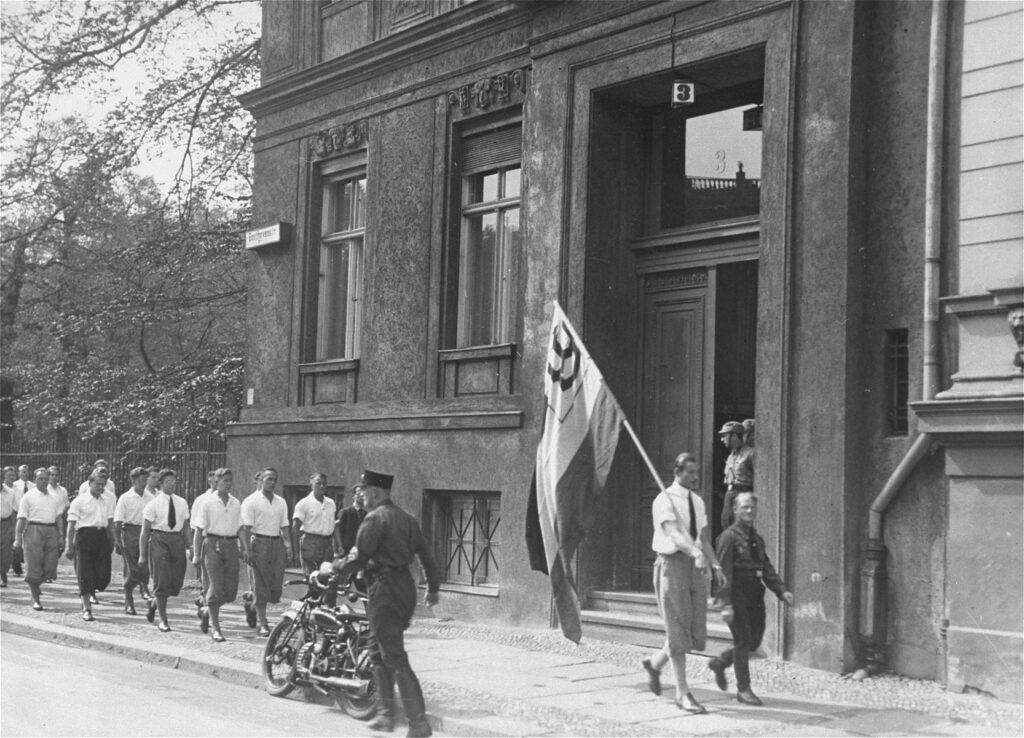
On May 6, 1933 — less than four months after Adolf Hitler became chancellor of Germany — members of the Nazi Sturmabteilung stormed a building in Berlin. They were not after weapons or state secrets. They were after books.
The building was the Institut für Sexualwissenschaft — the Institute for Sexual Science — the world’s first institution dedicated to the study of human sexuality and gender. Founded in 1919 by Magnus Hirschfeld, a gay Jewish doctor and sexologist, it had spent fourteen years providing gender-affirming healthcare, counseling, and legal support to transgender people who traveled from across Europe to access care they could find nowhere else. Its library held tens of thousands of documents — patient records, research, a century of evidence that gender diversity was not a modern aberration but a fundamental feature of human experience.
The Brownshirts seized everything. Four days later, in Berlin’s Opernplatz, they burned it.
The footage survives. You can watch Nazi youth heaping Hirschfeld’s books onto a pyre while a voiceover declares the German state has committed the intellectual garbage to flames. It was among the first and largest of the Nazi book burnings. Most people who have seen the footage don’t know what was being burned, or why. The erasure, in other words, was remarkably successful.
We are writing about it now because the logic of that bonfire has not disappeared. It has, in recent years, found new expression.
Let us begin with a claim that should not be controversial but has somehow become one: transgender people have always existed.
This is not a political assertion. It is a historical and anthropological one. The hijra of South Asia have been recognized for centuries as a distinct gender category. The fa’afafine of Samoa, the two-spirit identities recognized in many Indigenous North American communities, the five genders of the Bugis people of Indonesia — these are not recent Western imports. They are longstanding cultural recognitions of something that human communities across time and geography have encountered: that some people’s inner experience of themselves does not map onto the sex assigned to them at birth, and that this is a feature of human diversity, not a malfunction.
What is genuinely new is not transgender people. What is new is the political mobilization to deny their existence, erase their history, and restrict their rights.
When the current administration issued an executive order declaring that the United States government would recognize only two sexes — male and female, fixed at birth and immutable — it presented this as a statement of biological fact. It was not. It was a statement of ideology dressed in the language of science, and the distinction matters.
The actual scientific consensus on sex and gender is considerably more complicated than a simple binary. Sex, as researchers describe it, is a multidimensional construct involving chromosomes, hormones, gonads, internal reproductive anatomy, and external genitalia — and these dimensions do not always align in the way a simple binary would predict. Intersex variations are estimated to occur in somewhere between 0.02 percent and 1.7 percent of the population. Chromosomal arrangements beyond XX and XY exist. Hormone profiles exist on spectrums. The body, it turns out, did not receive the memo about the binary.
Peer-reviewed research published in 2025 notes that policies invoking biological essentialism to enforce a rigid gender binary “misrepresent scientific consensus, which increasingly supports nonbinary understandings of sex and gender.” The groups most loudly insisting otherwise are not making a scientific argument. They are making a political one.
History is a useful corrective here. The Nazis did not begin by putting people in camps. They began by deciding that certain people’s existence was a problem — a threat to social order, to the health of the nation, to the protection of women and children. The rhetoric was protective. The target was malleable.
Hirschfeld’s Institute was looted not only because it served transgender and homosexual people but because it also supported abortion rights, contraception, and women’s liberation. In the Nazi framing, all of these were connected — symptoms of the same corrosive liberalism that needed to be purged. The support of autonomy for women, or equality for sexual minorities, was labeled “cultural Marxism” — a phrase that should sound uncomfortably familiar to anyone paying attention to contemporary rhetoric.
What history demonstrates, with depressing consistency, is that when authoritarian movements begin by targeting the most marginalized group they can find, they do not stop there. The transgender community has served, in this political moment, as a test case: not because transgender people pose any genuine threat to anyone, but because the movement targeting them needed to establish the principle that certain people’s existence can be legislated away. Once that principle is established, the question is only who comes next.
The claim — prominent in TERF discourse and increasingly in mainstream political conversation — is that transgender rights come at the expense of women’s rights. This framing has a serious problem: it is being advanced by the same political movement that is simultaneously eliminating women’s reproductive rights, rolling back protections against workplace discrimination, cutting maternal healthcare, and pushing women out of academia, the military, and public life. The people most loudly claiming to protect women from transgender people are, in nearly every case, the same people working most actively to harm women.
Transgender women are not the threat to women. They are targets of the same threat.
Hirschfeld understood this. His work encompassed abortion rights, contraception, feminism, and the rights of gender-nonconforming people as a unified project — because they all challenge the same underlying structure: a social order that enforces rigid hierarchies by controlling who gets to be a full person, and who doesn’t. The Nazis burned his library because he understood that connection. We would do well to understand it too.
The books that were burned in Berlin in May 1933 contained the records of people who had finally found a place where they could exist as themselves. Those people did not stop existing because their records were destroyed. They kept living, kept being who they were — just without the protection, the documentation, the evidence that what they were was real and had a name.
That is what erasure does. It does not eliminate the people. It eliminates the protections.
We are watching a version of this play out in real time. None of this will make transgender people stop existing. They have always existed. They will continue to exist. What is being eliminated is the infrastructure of dignity that makes it possible to live openly, safely, and fully. And that should concern everyone — because the principle being established, that a government may define some people out of legal personhood, has never, in the history of its application, stopped at the first group it was tested on.