There’s a particular kind of disorientation that comes from watching something fall apart slowly, then all at once.
For decades, the signs were there. Wages that didn’t keep up. Towns that lost their anchor employers and never recovered. A healthcare system that worked better the more money you had. A political process that seemed increasingly responsive to donors and decreasingly responsive to voters. Most of us noticed these things. Many of us talked about them. But the overall shape of it — what it was adding up to — was harder to see clearly while you were living inside it.
It’s clearer now.
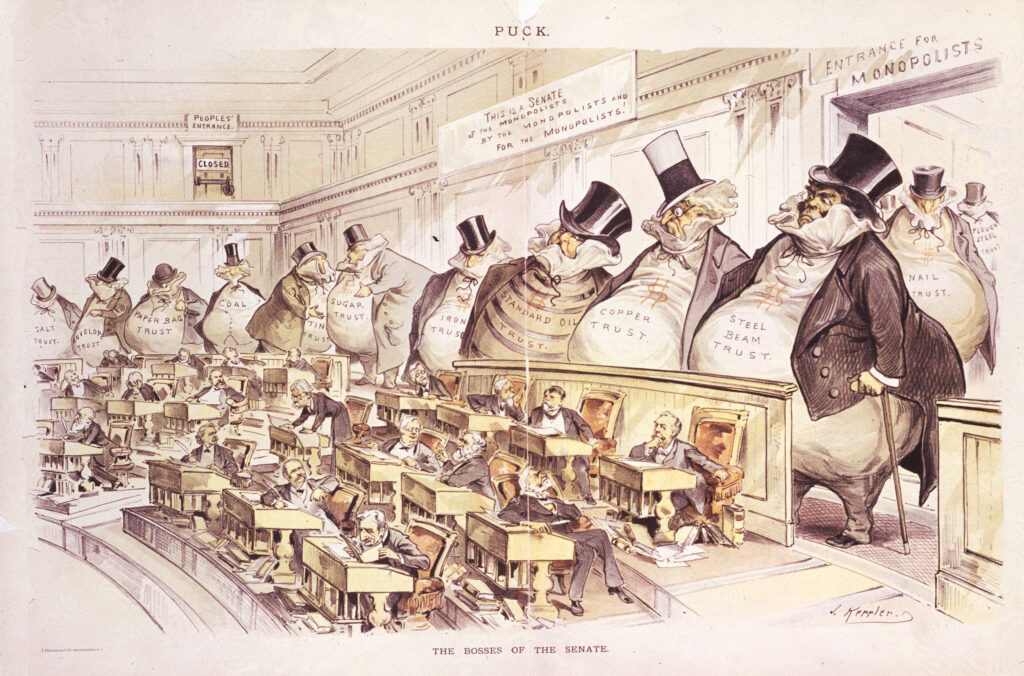
What we’re living through isn’t a glitch in an otherwise functioning system. It isn’t a temporary crisis that will resolve itself when the right person gets elected or the wrong one is voted out. It’s the predictable result of forty years of policy choices that allowed wealth to concentrate at the top of the economy to a degree not seen since the Gilded Age — and then allowed that wealth to purchase something far more valuable than luxury: influence over the systems that govern everyone else.
That’s the argument at the center of this publication. Not that rich people are uniquely evil, or that capitalism is irredeemably broken, or that the situation is hopeless. The argument is simpler and, we think, more useful: when wealth concentrates without limit, democracy doesn’t stay intact. Power follows money. It always has. What’s different about this particular moment is the scale and the speed — and the technology.
The billionaires who have come to dominate our political landscape didn’t emerge from nowhere. They are, in large part, the products of a specific sector: technology. And the platforms, algorithms, and artificial intelligence systems they built didn’t just make them wealthy — they gave them something unprecedented: direct, scalable access to the information environment that the rest of us live inside.
Consider what that means in practice. The platforms where hundreds of millions of people get their news, form their opinions, and communicate with each other are owned by individuals with explicit political agendas and no democratic accountability whatsoever. The AI systems now being woven into hiring decisions, healthcare protocols, content moderation, and government services are built and controlled by a small number of private actors. The infrastructure of public discourse has been quietly privatized, and the people who own it are not neutral.
This isn’t a conspiracy theory. It’s a business model, playing out in plain sight.
What it produces — the deliberate amplification of outrage, the erosion of shared facts, the replacement of democratic deliberation with engagement metrics — has a name, even if it’s one people use cautiously: it looks a lot like the conditions under which authoritarianism grows. Not the jackbooted kind of Hollywood imagination, but the quieter kind: the kind where institutions are hollowed out from the inside, where the rule of law becomes selectively applied, where the people who were already vulnerable become dramatically more so, and where dissent becomes increasingly costly.
We started Public Reckoning because we believe the first task is clarity.
Not the clarity of a simple answer — there isn’t one — but the clarity of seeing the system whole. Of understanding how the pieces connect. Of recognizing that the attack on transgender rights and the attack on union organizing and the defunding of the EPA and the takeover of social media platforms are not separate culture war skirmishes but expressions of the same underlying logic: a logic that says some people’s lives, livelihoods, and rights are negotiable when they stand in the way of concentrated power.
We write for people who are paying attention and want to understand what they’re seeing. We write for people who are exhausted by the noise and want something that cuts through it. We try to be clear without being simplistic. We try to be urgent without being alarmist.
A reckoning, in the old sense, meant an accounting. A moment of tallying up — what was spent, what was owed, what remained. Navigators used it to figure out where they were when they couldn’t see the stars.
We’re in that kind of moment. The landmarks have shifted. The old maps don’t quite work. What we’re committed to, in this space, is looking at it steadily. Naming what we see. Following the money, the power, and the consequences — particularly for the people who bear the most of them.
That’s the reckoning. We’re glad you’re here for it.