On January 20, 2025, Donald Trump took the oath of office in the Capitol Rotunda, flanked not by his cabinet but by the men who own the platforms most Americans use to understand the world. Mark Zuckerberg and his wife occupied prime seats. Jeff Bezos attended with his fiancée. Elon Musk, who had donated more than $270 million to Trump’s campaign, stood close enough to be mistaken for a co-president — a role he would, in subsequent months, arguably inhabit. Also present: Google’s Sundar Pichai, Apple’s Tim Cook, and the CEO of TikTok.
Senator Chris Murphy watched the scene and posted on social media: “All you need to know. The billionaires are in charge. Not you.”
It was a clarifying moment. Not because it revealed something new — the convergence of technology wealth and political power has been building for decades — but because it was so public, so unashamed, so stripped of the usual pretense that these men were simply neutral platform operators with no stake in political outcomes. They were not in the audience. They were on the stage.
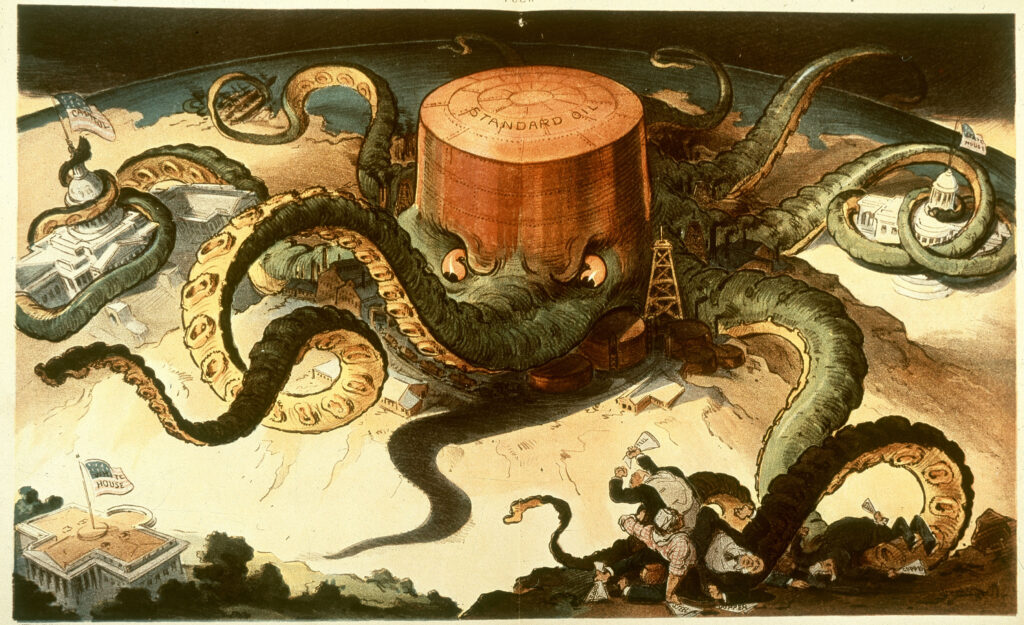
The technology sector has, over the past thirty years, produced a level of wealth concentration without precedent in American history. A handful of companies — Meta, Amazon, Google, Apple, Microsoft — now touch virtually every aspect of daily life. They carry our communications, deliver our goods, curate our news, store our data, and increasingly make decisions about our healthcare, our employment, and our access to public services. They are not regulated like utilities, though they function like them. They are not accountable like governments, though they exercise something very like governmental power.
The men who built and control these companies — and they are, almost without exception, men — did not acquire merely money. They acquired infrastructure. The infrastructure of attention, of information flow, of the public sphere itself.
Elon Musk bought Twitter in 2022 for $44 billion, renamed it X, fired most of its trust and safety staff, reinstated thousands of previously banned accounts including prominent white nationalists, and transformed what had been a messy but functional public square into an amplifier tuned specifically to his own political frequency. By 2025 he was running the Department of Government Efficiency — an unofficial body with access to federal systems and data, no congressional authorization, and no democratic accountability of any kind.
Mark Zuckerberg’s arc is its own study in moral flexibility. Facebook banned Trump after January 6th, 2021. Four years later, Zuckerberg was dining at Mar-a-Lago, donating $1 million to Trump’s inaugural fund, settling a $25 million lawsuit, appointing Trump allies to Meta’s board, and announcing the elimination of Meta’s fact-checking program. Asked by a reporter whether Zuckerberg was responding to Trump’s previous threats against him, Trump replied: “Probably.”
Jeff Bezos, owner of both Amazon and the Washington Post, blocked his paper’s planned endorsement of Kamala Harris before the 2024 election. In February 2025 he announced that the paper’s opinion section would henceforth focus on “personal liberties and free markets.” Subscriptions dropped. Senior journalists resigned. Amazon, meanwhile, announced a $40 million deal to produce a documentary about Melania Trump.
The question worth asking is not whether these men are personally bad. It is what their choices reveal about the structure that produced them — and what that structure is doing to the rest of us.
What they share is a set of interests: deregulation, favorable treatment of AI development, protection from antitrust enforcement, and freedom from democratic accountability. They are not buying a president. They are buying an operating environment.
In exchange, they are providing something the current administration needs urgently: control of the attention economy. These executives oversee platforms that virtually all Americans engage with. For an administration whose political power has always been rooted in its ability to dominate the information environment, that is not a minor asset. It is the ballgame.
The consequences for the rest of us are not abstract. When Meta drops fact-checking on platforms used by three billion people, misinformation spreads more freely. When an algorithm is quietly tuned to amplify certain voices and suppress others, public discourse shifts in ways most users will never detect. When the owner of a major newspaper kills an endorsement and pivots the opinion page toward a specific economic ideology, the information landscape narrows. These are not neutral technical decisions. They are political acts.
In his farewell address, Joe Biden warned specifically about the rise of a “tech-industrial complex.” The political scientist Steven Levitsky described the scene as “patrimonialist” — a style of governance in which the leader uses state power to reward allies and punish enemies.
What is new about this particular moment is the combination: unprecedented private control of the information infrastructure of democracy, combined with a political movement that has demonstrated its willingness to use that infrastructure as a weapon.
Zuckerberg looked at the political landscape, calculated the risks, and decided that submission was less costly than resistance. Bezos made the same calculation. They are not wrong, on their own terms. The problem is that their terms — the terms of private actors managing private risk — have nothing to say about what the rest of us lose when the infrastructure of public life is managed as a personal asset.
The men were on the stage. The rest of us were not. That is the problem. And it is, at its root, the same problem this publication exists to write about: what happens to everyone when power concentrates beyond accountability, and who pays the price when it does.